LiveInternetLiveInternet
—Поиск по дневнику
—Подписка по e-mail
—Постоянные читатели
—Статистика
Всё что нужно знать о нагуре
Автор Джим Райн
Фото Джим Райн
Название— More than you want to know about Nagura. (LONNNNNG)

Я начал с простого поиска в гугле. 95% результатов, были люди.
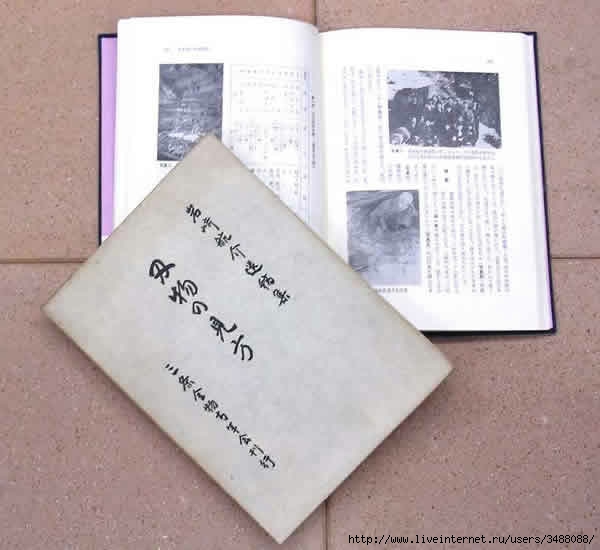
Шахта юнмикаваширо (纯三河白- я вовсе не уверен, в чтении иероглифоф) в префектуре Аити, единственное место в Японии, где добываются нагура и где Ивасаки нашел подходящую нагуру для лучшей заточки и полировки режущей кромки. Мало того, он определил различные слои в шахте, и с помощью геолога Асано разделил их на основе эффекта полировки, скорости и чистоты работы.

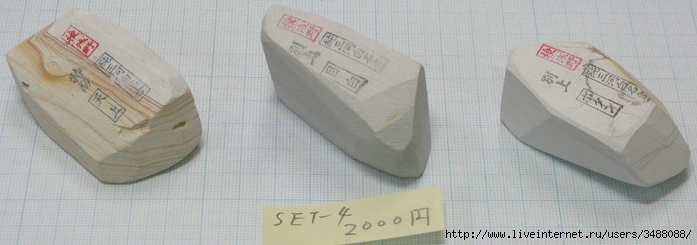
В будущем я буду продолжать изучать нагура и надеюсь, и не только для того, лучше понять, почему они необходимы и как лучше использовать различия между тремя типами нагур.
Нагура
Нагура. Nagura 名倉 — это горная порода (вулканический туф), применяется как абразив, обладающий уникальными свойствами, добывается около Mikawa, в префектуры Aichi. Видов нагур довольно много, но для заточки бритв необходимы только с 4 типа: Botan, Tenjyou, Mejiro, Koma (ботан, тенджу, меджиро и кома).
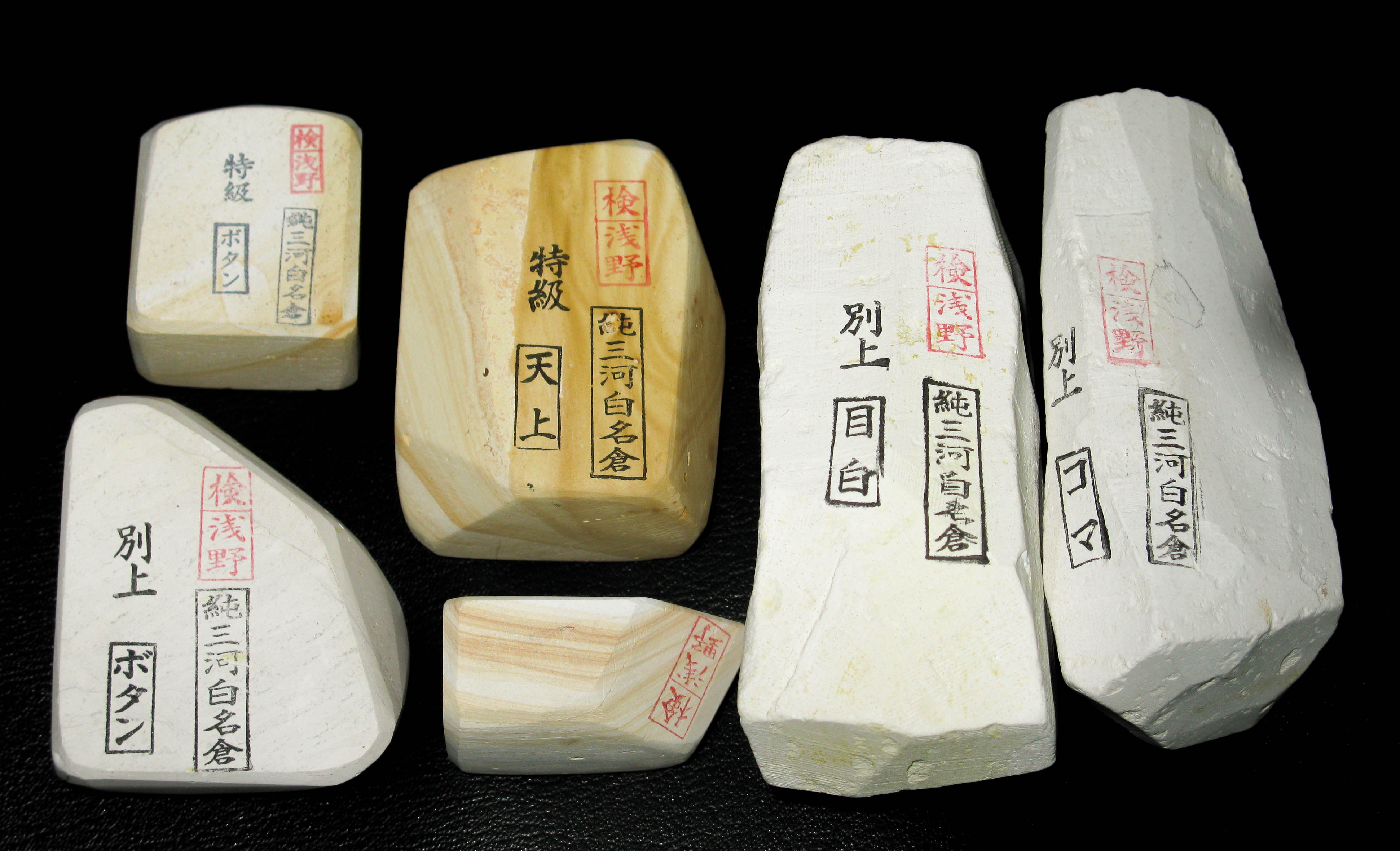
1) Koma Nagura コマ名倉/細名倉
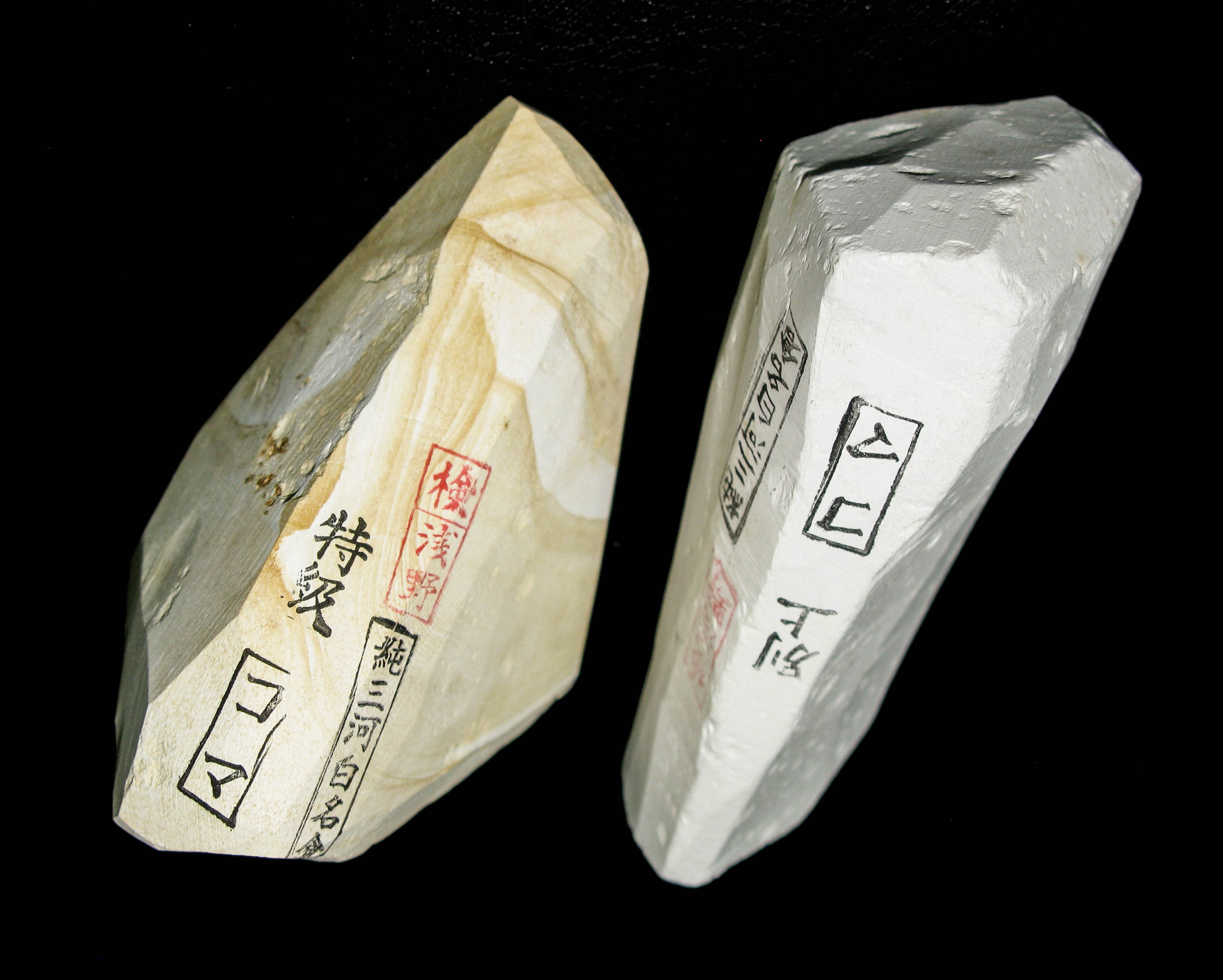 Koma Nagura コマ名倉/細名倉
В переводе возможно «тонкая» точнее трудно сказать, так как написано в катакана.
2) Tenjou Nagura 上名倉.
В переводе возможно «Белый глаз». Среднего диапазона нагура между Botan и Koma.
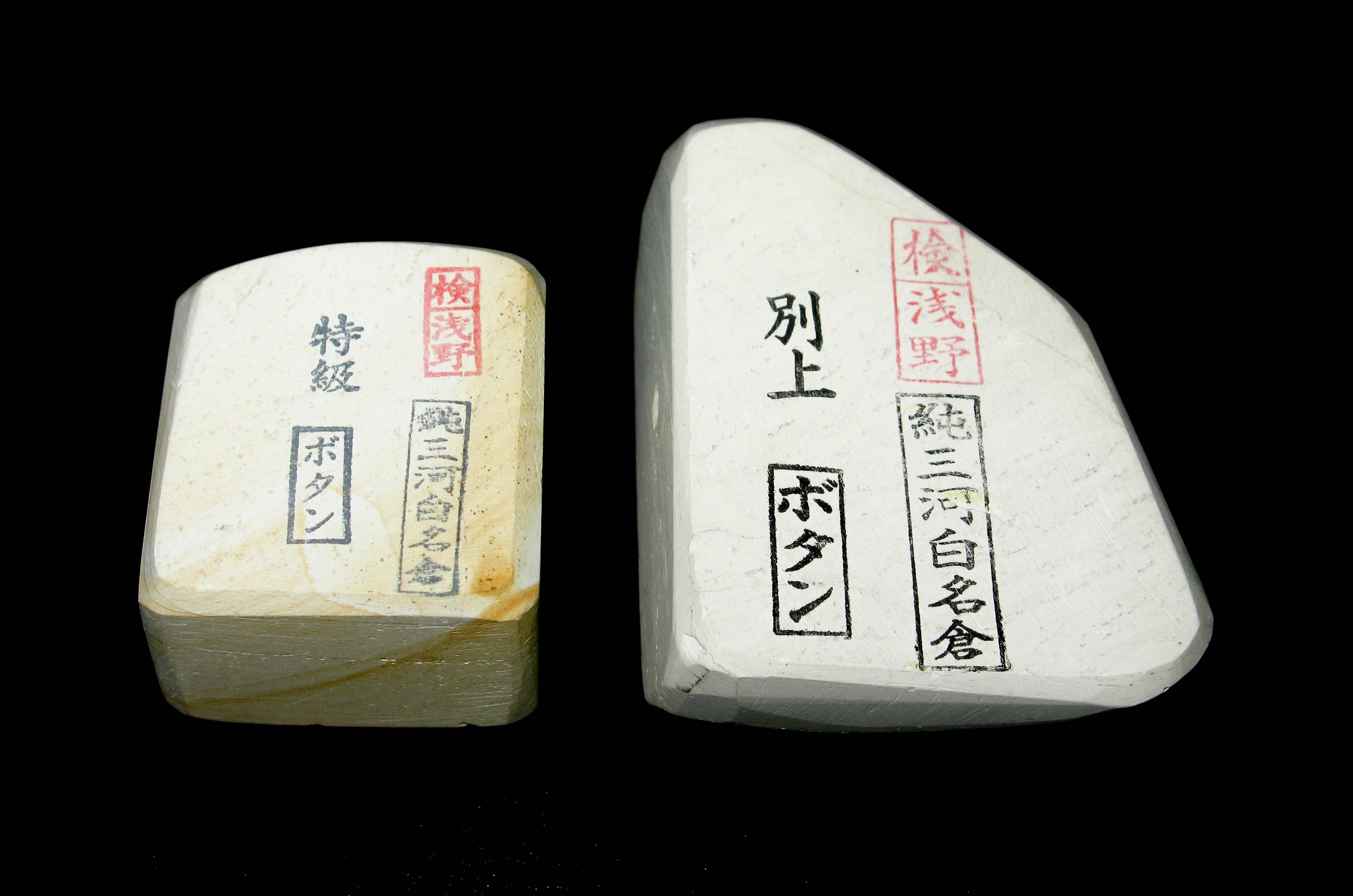 Botan Nagura ボタン名倉.
В переводе возможно «пионы». Самая грубая Nagura, используемая с бритвами. Работает очень быстро, используется для основной заточки. (по руководству Ивасаки)
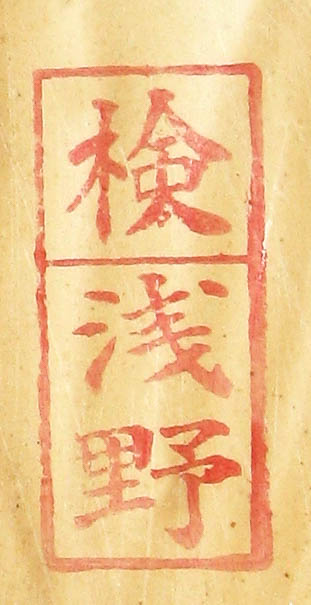 Nagayuki Asano Stamp
Доктор Kosuke Iwasaki, полагал, что Вы можете использовать различные Nagura на разных стадиях процесса заточки на одном и том же камне Nakayama. Это позволит вам произвести заточку кромки до готовности бритвы к бритью без необходимости использования других камней.
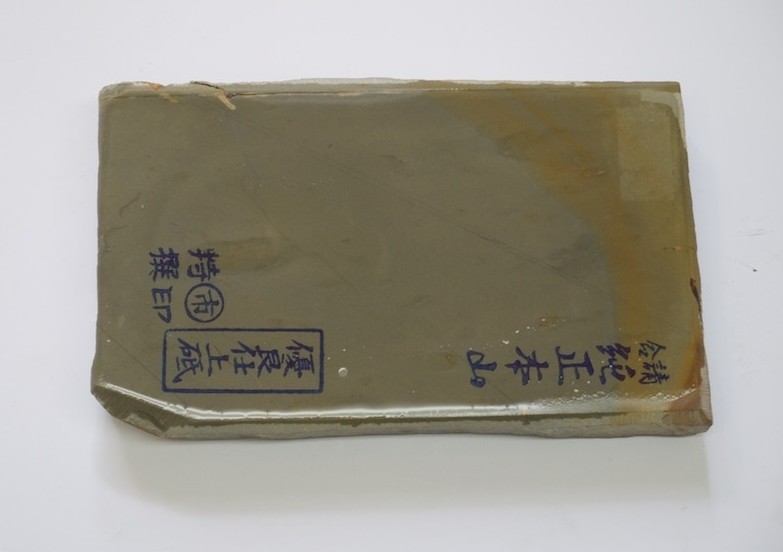 NAKAYMA MARUKA MARUICHI ASAGI LV 5
Однако, чтобы получить максимальную отдачу вашего J-NAT, он считал, что на окончательный стадии заточки надо использовать не Nagura, а на tomonagura.
О заточке на японских натуральных камнях с использованием нагура здесь: Заточка на японских природных камнях
Еще есть Tsushima Nagura 対馬名倉, которая добывается не в в горе Miwamura, что в префектуре Aichi, как вышеперечисленные «The true Mikawa Shiro Nagura stones», а в другом месте ( Tsushima, Nagasaki Prefecture, её добывают с морского дна ) и она считается весьма тонкой (возможно самой тонкой в Японии, #1000-2000 grit) и довольно редкой. Также Tsushima Nagura может использоваться как промежуточный камень и при полировке нихонто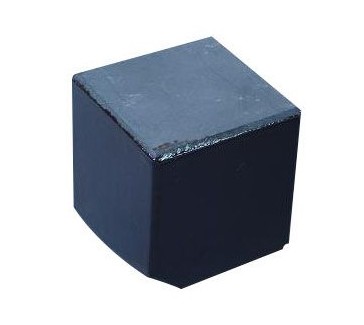
Много интересного о Нагура Вы можете прочитать у наших друзей: Нагура (Nagura 名倉)
Купить наборы (сеты) нагура в Дании: http://www.japanesenaturalstones.com/
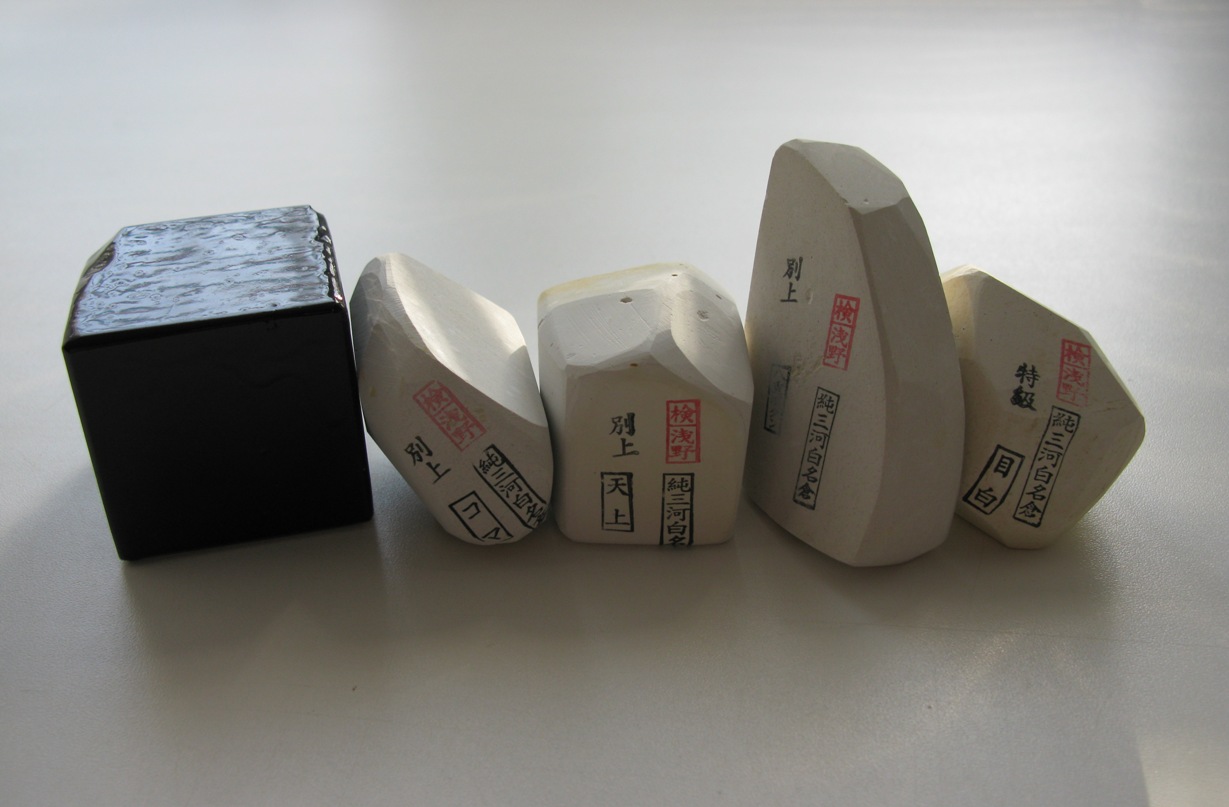
При подготовке статьи использованы фотоматериалы Sandr
Leave a Reply Отменить ответ
Для отправки комментария вам необходимо авторизоваться.
Нагура для водников ( англ. nagura, яп. 名倉 )
Модератор: тень


в данном случае нагура просто не нужна, слишком крупное зерно у камня
у японцев применение нагуры считается целесообразным
только на тонких доводочных и полировочных камнях
в общем тех, у которых зерно 3000 и тоньше.
на практике можно указать границу в 2000 grit JIS, все, что ниже можно использовать без нагуры и без суспензии, включая и 2000.
суспензия важна для получения более чистой
и хорошо доведенной поверхности
400 grit камень в полной мере можно считать обдирочным,
на этапе обдирки забота по большей части о придании нужной формы
( т.е. геометрии ), но никак не о чистоте поверхности,
а и потому ни суспензии, ни нагуры не актуальны.
надо было сказать еще, что нагура способствует удержанию на поверхности камня частичек расколовшегося и выпавшего из связки зерна и тем самым способствует получению более чистой поверхности за меньшее время
ну и ход при заточке с нагурой получается более плавный, что способствует более точным движениям
ЧТО ТАКОЕ НАГУРА, ПОЧЕМУ ОНА ТАК НАЗЫВАЕТСЯ И КАКИЕ БЫВАЮТ ЕЁ РАЗНОВИДНОСТИ
============================================================================
The true Mikawa Shiro Nagura stone is mined from the 12 layers of the Miwamura mountain in the Aichi prefecture. The four famous and most usable strata are Botan, Tenjo, Mejiro, and Koma.
Koma: The finest particles; used for JP swords.
Mejiro: Very fine; prepares edge for final finishing stage; the best for razors
Tenjo: Intermediate grit; mean for light repairs; white ones are soft and fast while ones with layers (usually yellow) are hard and slow
Botan: coarsest and fastest; meant for major repairs
Wednesday, September 16, 2009
More than you want to know about Nagura. (LONNNNNG)
I’m taking this whole Japanese shaving thing to heart, learning as much as I can about all that I can, and it’s really getting interesting. To me, at least.
People who are familiar with Japanese hones will have heard the word «Nagura» before. Those who haven’t, well, basically when you use a natural Japanese stone to sharpen things, very often it will have a smaller stone with it that you rub all over the surface of the hone to make a thin mix of water and grit rubbed off that smaller stone. The smaller one is called a «Nagura». This is used in traditional Japanese honing to help increase the range of a hone’s effect—often, a hone with a nagura will polish faster and more smoothly than just a hone itself. Why? I don’t know. But I plan to find out.
Now, here’s the thing that got me going on this—people dealing with straight razor honing have started using this word to describe ANY stone you use to make a slurry paste on your hones, and so we get things like «Cotigura», a portmanteau of «Coticule», the Belgian wonderstone, and «Nagura». Or people call the DMT card they use to raise a slurry on their stones a Nagura. Even Japan isn’t immune to it—every little stone included with the synthetic water stones are called Nagura, as well. So I used to think that the word just meant «slurry stone», until one day in a thread on SRP where I posted videos of me honing on a Japanese natural stone using a slurry, someone asked me «Is that stone a Nagura or a Nakayama?» That question threw me. As if, Nagura must mean something much more than I had thought.
I was really confused. and then I started thinking about the name «Nagura.» It doesn’t have a meaning, or not at least one that is related to what it does. The kanji for the name, 名倉, has NOTHING to do with stones, or polishing or honing. Which is odd—Japanese is usually a pretty pragmatic language when it comes to objects. The word for a hone, 砥石 (to-ishi) translates directly to «polish stone». (Or, an example I like much better, the word for honey 蜂蜜, «hachimitsu», is «bee syrup».) But Nagura? Roughly, it means something like «Famous Storehouse». That looks less like an object name, and more like a PERSON name.
Which led me on a merry chase.
I started with a simple search on the term. 95% of the hits on Google were for people. Hmmm.
Then came the motherlode. There is a seller on the Japanese Yahoo Auction site that keeps listing Japanese hones and Nagura, and they happen to have a webshop, which happens to include the word «nagura» in the URL. I investigated, and these guys take Nagura SERIOUSLY. They have pages and pages about them, and this stuff is amazing. So I started studying.
Nagura, as it turns out, are essentially super-fine hones. Due to reasons like highly variable hardness, size and immense rarity (read price), are not suitable for making actual hones. Instead, they are broken into small pieces and used with the hones from more suitable sources (like the Maruka Nakayama mine in Kyoto). And like the Nakayama mine, there is really only one serious place to get a Nagura.
According to the late Kousuke Iwasaki, when he first started making razors he had trouble with honing. he was getting breaks and chips on his edges, which he eventually found came from the inferior nagura that were being sold by the merchants—they were cheap, and easily found, and of substandard quality. So he began searching for a long lost source for the Nagura that had bene sued for centuries in the polishing of Katana. He took this selection very seriously; in his book «刃物の見方» («Understanding Bladed Implements»), he said something along the lines of «If a razor maker can not hone a razor well, the razor will not shave well, and people will think that the razor is no good.» So he worked on researching just where the best hones, and the best nagura to use with them, could be found.
The Junmikawashiro mine (純三河白-I’m not at all sure of that reading) in Aichi prefecture is the only place in Japan that produced the Nagura that Iwasaki-san found suitable for the finest honing and polishing. Not only that, he identified the different seams of the mine, and with the help of geologist Nagayuki Asano divided them based on their polishing effects, speed, and purity.
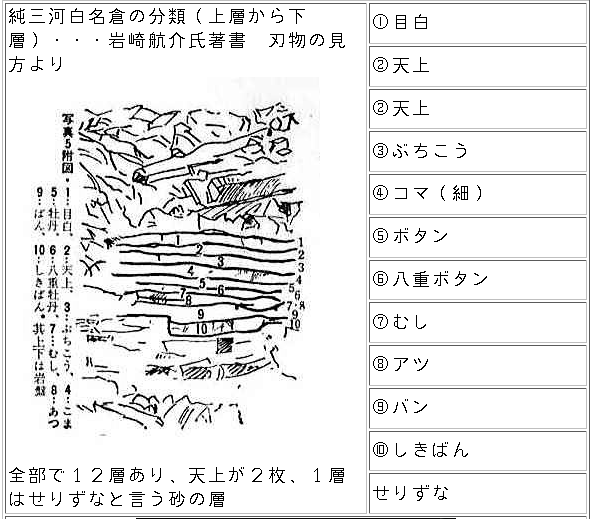
The ten seams of the mine are shown abov, in a page from Iwasaki’s notebook.
They are:
1. Mejiro (White-eye)
2. Tenjou (heaven)
3. Buchikou
4. Koma (very fine)
5. Botan (Tree Peony)
6. Layered Botan
7. Mushi (nothing)
8. Atsu (??)
9. Ban (??)
10. Shikiban.
I personally am still learning the differences between these seams. I know that the Koma and the Mejiro are supposed to be the finest, with Tenjou next, while the Botan is fine and fast cutting.
So I bought one of each. (Well, no Koma. yet. )
I’m going to keep studying these, and I hope soon not only to have a better grasp of WHY you need them, but how to use them and the differences between the three types. But what I fear, and what will truly be something to look out for, is.
Nagura Acqusition Disorder.


Nagura
名倉
Direct translation, «Famous Warehouse» (not related to anything specific).
The best nagura are sourced from a mountain near Mikawa town, in northern Aichi prefecture, Japan.
These stones are small, soft chalky stones used to create a succession of slurry «pastes» (In Japan called «Tojiro», hone juice, or «Todoro», hone mud.).
Come in a total of 12 varieties, but only 4 concern razor honing. See also «Koma,» «Botan,» «Tenjou» and «Mejiro.»
из всех видов нагура для тонкой доводки подходят лишь несколько:
1) Koma Nagura
コマ名倉/細名倉
Direct translation possibly «fine» but difficult to tell, as usually written in Katakana.
The finest nagura, and most expensive.
Some call this «Tomonagura,» but this is a historical misnomer (according to Iwasaki’s Barbering manual). 
2) Tenjou Nagura
天上名倉
Direct translation «Heaven, Sky».
Finer than the Mejiro, but still a midrange nagura.
3) Mejiro Nagura
目白名倉
Direct Translation «White-eye».
A middle-range nagura, between Botan and Koma
4) Botan Nagura
ボタン名倉
Direct Translation, «Peony».
The roughest nagura stone used with razors. Cuts very fast.

Нагура камень для чего нужен
Всё бы ничего, но вопрос нагуры для меня остался открытым- у нас её практически не встретить, а без неё точить не очень. В каком-то смысле её у меня заменяет пока зелёный сланец от Гусева, но вязкость кашицы оставляет желать лучшего, да и перерасход абразива тоже не самая приятная вещь. Встречал упоминание об использовании мела, но пока не решаюсь на эксперименты- камень пока еще новый)
И как вы без неё обходитесь?
У нагура 4 основных функции:
— подравнивать мелкие камни. Для этого лучше подходит иск. нагура, зернистость на ней ок. 400, а связка нерастворимая. Нанива, например, кладет ее в комплекте со всеми своми камнями Chosera от 400 до 10000. Крупные камни лучше всего равнять порошком карбида кремния.
— «засаливать» камень частицами нагуры, чтобы нивелировать «вылет» разных зерен над поверхностью камня (для хороших дорогих водников это не особо актуально)
— не давать вам выдавливать воду из под клинка при заточке
— для эффективной работы слой СОЖ должен иметь оптимальную толщину (кстати, прямой связи между толщиной этой пленки и вязкостью жидкости нет)
можете попробовать использовать в качестве замены зубной порошок. Соотношение с водой где-то 1:2.
на этапе «засаливания» им поверхности,
вы поймете сколько его сыпать на камень
— если его будет слишком много, Вы это почувствуете.
1) Что такое НАГУРА?
В традиционной японском понимании НАГУРА
— это разновидность минерала типа вулканический туф,
который добывается в месте под названием Микава,
что в префектуре Айти ( http://en.wikipedia.org/wiki/Aichi_Prefecture ).
Минерал этот обладает высокой абразивной способностью
и используется для традиционной японской полировке и заточке.
Преимущественно для бритв (камисори) и мечей (нихонто).
В настоящее время НАГУРА используют преимущественно для увеличения абразивной способности натуральных камней (тоищи ) путем наведения на них абразивной суспензии на которой и производят заточку.
4) Чем её можно заменить?
Полноценной замены для НАГУРА не существует,
но есть некоторые паллиативы, например кусочки мягковатых камней
не содержащие твердых включений,
например СУИТА, ЦУСИМА КУРО НАГУРА, УМЕГАХАТА, ООХИРА и т.д.
Для тонкой доводки иногда используют ТОМО-НАГУРА,
то есть кусочек, отпиленный от того-же камня,
которым наводят суспензию.
Никакие синтетические заменители НАГУРА не подходят
в качестве замены при доводке на натуральных камнях.
5) Что за «НАГУРА» предлагается для синтетических камней
или даже уже идет в комплекте?
6) Где можно почерпать доп. информацию о НАГУРА
в данном случае нагура просто не нужна, слишком крупное зерно у камня
у японцев применение нагуры считается целесообразным
только на тонких доводочных и полировочных камнях
в общем тех которые АВАСЕ-ДО и СИАГЕ-ДО
400 grit камень в полной мере можно считать обдирочным,
на этапе обдирки забота по большей части о придании нужной формы
( т.е. геометрии ), но никак не о чистоте поверхности,
а и потому ни суспензии, ни нагуры не актуальны.
надо было сказать еще, что нагура способствует удержанию на поверхности камня частичек расколовшегося и выпавшего из связки зерна и тем самым способствует получению более чистой поверхности за меньшее время
ну и ход при заточке с нагурой получается более плавный, что способствует более точным движениям
т.е. она может играть роль смазочной субстанции
за счет дробления её частичек снижая трения
поясняю, почему так было сказано: мел может содержать какой угодно абразивный мусор и клеевую связку, к чему это может привести сами можете догадаться.
Мои эксперименты с мелом показали, что он не годится.
( по крайней мере тот, что нынче продается ).
Если кому-то интересно мое мнение, то скажу, что самый правильный вариант, все таки, это кусочек известняка, выбранный таким образом, чтобы у него была максимально однородная струкрура, и чтобы в нем не было никаких примесей и включений. Подойдет также и доломит.
Но ни в коем случае не мрамор
Может, и притиры надо посыпать чем-нибудь вроде этого? 
The true Mikawa Shiro Nagura stone is mined from the 12 layers of the Miwamura mountain in the Aichi prefecture. The four famous and most usable strata are Botan, Tenjo, Mejiro, and Koma.
Koma: The finest particles; used for JP swords.
Mejiro: Very fine; prepares edge for final finishing stage; the best for razors
Tenjo: Intermediate grit; mean for light repairs; white ones are soft and fast while ones with layers (usually yellow) are hard and slow
Botan: coarsest and fastest; meant for major repairs
Dr. Kosuke Iwasaki, Mr. Shigeyoshi Iwaski’s father, believed that you could use different nagura in different stages of the honing process on the same Nakayama stone. This would allow you to progress from a dull edge to a shave ready edge without the need for other stones. However, to gain the most out your J-nat, he believed that your final nagura wasn’t a nagura at all but a tomonagura.
Tomo = same
Nagura = slurry stone
It means a slurry stone that is identical to your finishing stone. If your stone is a Nakayama Kiita, then you would use a small piece of a Nakayama Kiita as your tomonagura. If your stone is an Ozuku Asagi, then you would use a small piece of an Ozuku Asagi as your tomonagura. It doesn’t have to be a piece broken off of your whetstone but it should have similar characteristics.
Since most of us don’t have a smaller yet identical piece of our Japanese whetstones, then a diamond plate is recommended. The diamond plate works because it’s harder than the whetstone. It will build a slurry made up entirely of particles from your finishing stone. Instead of the slurry of an 8K nagura, you’re getting the slurry of a 20K+ whetstone. Those particles break down and get smaller and finer, which will refine your razor’s edge far beyond the purported grit of the stone. Only experience will tell you how many times you must repeat the process of building and diluting the slurry.
The Mejiro nagura is softer than the whetstone. It will break down and create a slurry of its particles, which are much coarser than those of your whetstone. As those particles break down, they can help bridge the gap from your intermediate finishing whetstone (Coticule, Shapton 16K, Shapton Pro 12K/15K, etc.) to your final finishing whetstone (Nakayama, Ozuku, etc.). However, they will never be as fine as the particles of your whetstone or tomonagura. That means there’s a level of edge refinement that you will never reach.
Wednesday, September 16, 2009
More than you want to know about Nagura. (LONNNNNG)
I’m taking this whole Japanese shaving thing to heart, learning as much as I can about all that I can, and it’s really getting interesting. To me, at least.
People who are familiar with Japanese hones will have heard the word «Nagura» before. Those who haven’t, well, basically when you use a natural Japanese stone to sharpen things, very often it will have a smaller stone with it that you rub all over the surface of the hone to make a thin mix of water and grit rubbed off that smaller stone. The smaller one is called a «Nagura». This is used in traditional Japanese honing to help increase the range of a hone’s effect—often, a hone with a nagura will polish faster and more smoothly than just a hone itself. Why? I don’t know. But I plan to find out.
Now, here’s the thing that got me going on this—people dealing with straight razor honing have started using this word to describe ANY stone you use to make a slurry paste on your hones, and so we get things like «Cotigura», a portmanteau of «Coticule», the Belgian wonderstone, and «Nagura». Or people call the DMT card they use to raise a slurry on their stones a Nagura. Even Japan isn’t immune to it—every little stone included with the synthetic water stones are called Nagura, as well. So I used to think that the word just meant «slurry stone», until one day in a thread on SRP where I posted videos of me honing on a Japanese natural stone using a slurry, someone asked me «Is that stone a Nagura or a Nakayama?» That question threw me. As if, Nagura must mean something much more than I had thought.
I was really confused. and then I started thinking about the name «Nagura.» It doesn’t have a meaning, or not at least one that is related to what it does. The kanji for the name, 名倉, has NOTHING to do with stones, or polishing or honing. Which is odd—Japanese is usually a pretty pragmatic language when it comes to objects. The word for a hone, 砥石 (to-ishi) translates directly to «polish stone». (Or, an example I like much better, the word for honey 蜂蜜, «hachimitsu», is «bee syrup».) But Nagura? Roughly, it means something like «Famous Storehouse». That looks less like an object name, and more like a PERSON name.
Which led me on a merry chase.
I started with a simple search on the term. 95% of the hits on Google were for people. Hmmm.
Then came the motherlode. There is a seller on the Japanese Yahoo Auction site that keeps listing Japanese hones and Nagura, and they happen to have a webshop, which happens to include the word «nagura» in the URL. I investigated, and these guys take Nagura SERIOUSLY. They have pages and pages about them, and this stuff is amazing. So I started studying.
Nagura, as it turns out, are essentially super-fine hones. Due to reasons like highly variable hardness, size and immense rarity (read price), are not suitable for making actual hones. Instead, they are broken into small pieces and used with the hones from more suitable sources (like the Maruka Nakayama mine in Kyoto). And like the Nakayama mine, there is really only one serious place to get a Nagura.
According to the late Kousuke Iwasaki, when he first started making razors he had trouble with honing. he was getting breaks and chips on his edges, which he eventually found came from the inferior nagura that were being sold by the merchants—they were cheap, and easily found, and of substandard quality. So he began searching for a long lost source for the Nagura that had bene sued for centuries in the polishing of Katana. He took this selection very seriously; in his book «刃物の見方» («Understanding Bladed Implements»), he said something along the lines of «If a razor maker can not hone a razor well, the razor will not shave well, and people will think that the razor is no good.» So he worked on researching just where the best hones, and the best nagura to use with them, could be found.
The Junmikawashiro mine (純三河白-I’m not at all sure of that reading) in Aichi prefecture is the only place in Japan that produced the Nagura that Iwasaki-san found suitable for the finest honing and polishing. Not only that, he identified the different seams of the mine, and with the help of geologist Nagayuki Asano divided them based on their polishing effects, speed, and purity.
The ten seams of the mine are shown abov, in a page from Iwasaki’s notebook.
They are:
1. Mejiro (White-eye)
2. Tenjou (heaven)
3. Buchikou
4. Koma (very fine)
5. Botan (Tree Peony)
6. Layered Botan
7. Mushi (nothing)
8. Atsu (??)
9. Ban (??)
10. Shikiban.
I personally am still learning the differences between these seams. I know that the Koma and the Mejiro are supposed to be the finest, with Tenjou next, while the Botan is fine and fast cutting.
So I bought one of each. (Well, no Koma. yet. )
I’m going to keep studying these, and I hope soon not only to have a better grasp of WHY you need them, but how to use them and the differences between the three types. But what I fear, and what will truly be something to look out for, is.
Nagura Acqusition Disorder.
Direct translation, «Famous Warehouse» (not related to anything specific).
The best nagura are sourced from a mountain near Mikawa town, in northern Aichi prefecture, Japan.
These stones are small, soft chalky stones used to create a succession of slurry «pastes» (In Japan called «Tojiro», hone juice, or «Todoro», hone mud.).
Come in a total of 12 varieties, but only 4 concern razor honing. See also «Koma,» «Botan,» «Tenjou» and «Mejiro.»
из всех видов нагура для тонкой доводки подходят лишь несколько:
1) Koma Nagura
コマ名倉/細名倉
Direct translation possibly «fine» but difficult to tell, as usually written in Katakana.
The finest nagura, and most expensive.
Some call this «Tomonagura,» but this is a historical misnomer (according to Iwasaki’s Barbering manual).
2) Tenjou Nagura
天上名倉
Direct translation «Heaven, Sky».
Finer than the Mejiro, but still a midrange nagura.
3) Mejiro Nagura
目白名倉
Direct Translation «White-eye».
A middle-range nagura, between Botan and Koma
4) Botan Nagura
ボタン名倉
Direct Translation, «Peony».
The roughest nagura stone used with razors. Cuts very fast.
есть еще Tsushima Nagura, которая также считается весьма тонкой и пригодной для тонкой доводки.
выглядит она вот так:
———-
О АЛМАЗНЫХ БРУСКАХ ВМЕСТО НАГУРА И ТЕРМИНЕ tomonagura ( ともなぐら 共名倉 )
———-
———-
О АЛМАЗНЫХ БРУСКАХ ВМЕСТО НАГУРА И ТЕРМИНЕ tomonagura ( ともなぐら 共名倉 )
———-
I do not have a DMT 1.2k so I cannot comment on that.
What I have is #200, #400 #600 and#1000 diamond stones.
I use #200 and #400 for flattening stones.
If you use the mud made by these stones you get big scatches from the fall apart diamonds.
If you make mud with #1000 you still get small scratches from mud with diamond residue.
These small scratches are not so significant at the hagane (hard steel part of the knife) but you can see it at the jigane (soft iron part).
But one of the features of honzan natural stones is to make the nice cosmetic look on jigane (the kasumi finish) so I will never recommend to make mud with diamond stones.
So I think even with 1.2k diamond stone you get small scratches. As I said the scratces are not so significant at the hagane. You must see it with sunshine.
Ken-san did you ever see such scratches?
You can try to sharpen without the mud made by DMT.
If you have other natural honzan stone you can try it as nagura to make mud. Compare the results please.
About tomonagura ( ともなぐら 共名倉 ).
Here Japanese has again 2 meanings.
There is a narrow term and a wider term.
People use it either way.
The narrow term is you use the same stone for nagura.
The wider term is you use another honzan stone to the honzan stone you have.